Part of Auckland Transport’s (AT) First and Final Leg (FFL) programme, which is aimed at encouraging people to use active modes to travel to train stations. The Western Line Explorer was developed to test ways to activate walking and wheeling to train stations, in line with AT’s FFL programme.
Western Line Explorer was a one-day, self-guided activation designed to encourage families to explore Auckland’s Western rail corridor.
The event was organised as a part of Auckland Transport’s (AT) First and Final Leg (FFL) programme which is aimed at encouraging people to use active modes to travel to train stations. The Western Line Explorer was developed to test ways of activating walking and wheeling to train stations in line with AT’s FFL programme.
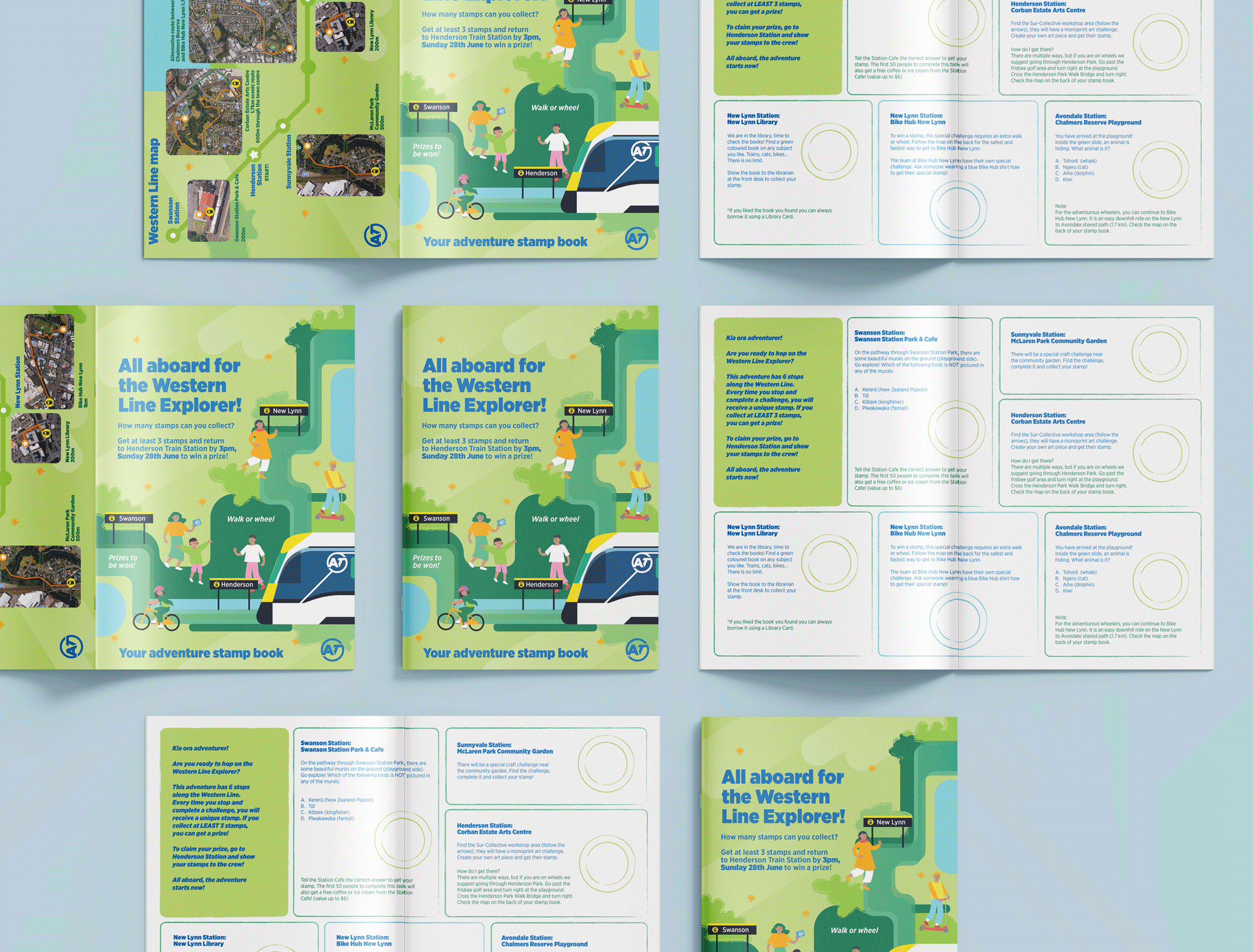
Starting at Henderson Station, participants collected a stamp book and began a ‘choose your own adventure’ scavenger hunt, travelling by foot, bike and train to a series of nearby locations and community destinations. Along the way, participants followed themed clues and discovered local highlights.
Along with Henderson Station, four other stations along the Western Line were activated for the event: Swanson Station, Sunnyvale Station, New Lynn Station and Avondale Station.
At the activity locations, participants received a stamp in their stamp book once they had completed the task. After they had received at least three stamps they could return to Henderson Station to claim a prize.
The Western Line Explorer was the first time an activation of this type had been organised by Crank. There were many variables in planning an activation that involved participants walking, wheeling and catching public transport.
Crank worked on the Western Line Explorer from the initial planning stages through to the delivery of the activation. Working collaboratively with community partners meant local knowledge was utilised, and this also helped to keep the overall costs down.
A key component was to promote a family-friendly experience that positions active and public transport as fun and low-pressure. Thinking about the needs of local families was an important consideration in this.
The activation was planned so families could participate at their own pace and complete as much as was possible for them. This included providing flexible start and finish times so families could attend around other Sunday commitments. Even though there were six activities across the five stations, only three stamps were required to receive a prize, allowing participants to choose which activities to go to and how long they wanted to spend at each one.
A diverse range of family groups attended, including families with toddlers, primary school aged children and teenagers. There was also at least one family with a wheelchair user, as well as a number of groups with no children.
Crank was involved in gathering feedback from participants, and used the activation as a way to listen to participants and hear their thoughts on multi-modal and active mode transport. The activation provided an opportunity to hear from participants as they were completing the activities, and also via an online survey when they finished.
Partnerships with the local community were vital in the success of the Western Line Explorer. Having a range of community partners ensured activities were varied and multiple destinations were activated. Working with the community is a key focus of Crank’s work, and the Western Line Explorer was a good example of how multiple community partners can be used for one event.
The Western Line Explorer had a mixture of new and old community partners. It was a great way to work with some partners again, and the new relationships developed with the first time community partners was a success. As mentioned, Crank has worked in West Auckland extensively, and the Western Line Explorer further enhanced Crank’s relationship with the local community.
There were also a few community organisations who were keen to participate but couldn’t make the date work. A log of these was kept in case of future activations in the area.
During the planning phase, Crank provided ideas for the activities, but allowed each community partner or business to develop their own. Giving a sense of agency allowed a varied range of activities to be developed. Crank ensured each activity aligned with the wider event, but encouraged community partners to think of unique experiences for their location. This provided participants with unique experiences which they may not have known were available in the area.
Promoting the event and communicating how it would run were key factors in the success of the activation. Crank created a new visual identity for the Western Line Explorer that remained within AT brand guidelines. Crank also designed the collateral and ran a promotional campaign.
The campaign included posting the digital collateral to local Facebook groups and advertising the activation on Auckland event websites. Posters were also printed and distributed to local primary schools, community centres and businesses. By running the campaign both online and physically a wide audience was captured, which translated into a high turnout on the day.
Crank also designed and installed wayfinding, which was essential to ensure participants could find the activities. The wayfinding worked in collaboration with the maps on the back of the stamp books, and kept participants on the right track as they made their way to the activity locations from the train stations.
On the day, Crank staff were on the ground to facilitate the running of the activation. This included coordinating the volunteers, managing health and safety protocols, as well as having conversations with participants and handling any issues that arose.
Alongside Crank, local community groups and organisations ran activities and engaged with participants.
Part of the delivery was ensuring participants could find the activities as they were required to make their own way from the station to the activity location. There were no marshals along the way, but maps were supplied on the back of the stamp book with safe routes to the activities. There were helpers stationed at each location, providing a level of guidance for the participants. Many of the participants were familiar with the area as the target demographic was local tamariki aged 5-10 and their whānau.
Alongside the project manager who travelled between locations, Crank had staff positioned at Henderson Station where participants began and ended their journey. The project manager relayed information to the volunteers at each activity, and the Crank staff at Henderson Station could brief participants before they began, and hear any concerns from participants when they returned to Henderson.
This model allowed for a high level of engagement, and by having conversations with participants at the beginning and the end of their journey, Crank staff could gather feedback about what worked well and what didn’t for future activations of this type.
The Western Line Explorer proved to be a popular activation, with over 330 people participating, exceeding the 150 Crank and AT had aimed for. Participants provided feedback after the event via an online survey, reflecting the positive feedback heard throughout the day. Responding to the question ‘What did you enjoy the most?’, responses included:
“We got to see places near the train stations that we didn't know were so close.”
“Seeing the smiles and joy the children were having using the trains whilst having a reason to get to each place and getting us adults back into using the trains and seeing more of West Auckland.”
“Exploring different areas. Really fun idea.”
“The entire thing! It was nice to walk from the station to different craft areas, great to have activities to do!”
“Seeing paths and spots you would not usually see and seeing how close areas are to train stations!”
The activation highlighted local destinations, and gave participants a way to try out using multi-modal transport to make local trips. A number of participants said they weren’t regular public transport users, and for those with bikes, many said they had not taken their bikes on the train before. The feedback received aligns directly with the aims of AT’s FFL programme.
It was also an opportunity to raise awareness that kids under 15 travel free on public transport on weekends, and was a way to encourage parents to register HOP cards to ensure their children could travel for free on weekends.
The success of the Western Line Explorer has shown the potential for further multi-modal activations across Auckland. The activation could be tailored to different audiences and trialled on the Southern or Eastern lines, or at the CRL stations.
Western Line Explorer was a one-day, self-guided activation designed to encourage families to explore Auckland’s Western rail corridor.
The event was organised as a part of Auckland Transport’s (AT) First and Final Leg (FFL) programme which is aimed at encouraging people to use active modes to travel to train stations. The Western Line Explorer was developed to test ways of activating walking and wheeling to train stations in line with AT’s FFL programme.
Starting at Henderson Station, participants collected a stamp book and began a ‘choose your own adventure’ scavenger hunt, travelling by foot, bike and train to a series of nearby locations and community destinations. Along the way, participants followed themed clues and discovered local highlights.
Along with Henderson Station, four other stations along the Western Line were activated for the event: Swanson Station, Sunnyvale Station, New Lynn Station and Avondale Station.
At the activity locations, participants received a stamp in their stamp book once they had completed the task. After they had received at least three stamps they could return to Henderson Station to claim a prize.
The Western Line Explorer was the first time an activation of this type had been organised by Crank. There were many variables in planning an activation that involved participants walking, wheeling and catching public transport.
Crank worked on the Western Line Explorer from the initial planning stages through to the delivery of the activation. Working collaboratively with community partners meant local knowledge was utilised, and this also helped to keep the overall costs down.
A key component was to promote a family-friendly experience that positions active and public transport as fun and low-pressure. Thinking about the needs of local families was an important consideration in this.
The activation was planned so families could participate at their own pace and complete as much as was possible for them. This included providing flexible start and finish times so families could attend around other Sunday commitments. Even though there were six activities across the five stations, only three stamps were required to receive a prize, allowing participants to choose which activities to go to and how long they wanted to spend at each one.
A diverse range of family groups attended, including families with toddlers, primary school aged children and teenagers. There was also at least one family with a wheelchair user, as well as a number of groups with no children.
Crank was involved in gathering feedback from participants, and used the activation as a way to listen to participants and hear their thoughts on multi-modal and active mode transport. The activation provided an opportunity to hear from participants as they were completing the activities, and also via an online survey when they finished.
Partnerships with the local community were vital in the success of the Western Line Explorer. Having a range of community partners ensured activities were varied and multiple destinations were activated. Working with the community is a key focus of Crank’s work, and the Western Line Explorer was a good example of how multiple community partners can be used for one event.
The Western Line Explorer had a mixture of new and old community partners. It was a great way to work with some partners again, and the new relationships developed with the first time community partners was a success. As mentioned, Crank has worked in West Auckland extensively, and the Western Line Explorer further enhanced Crank’s relationship with the local community.
There were also a few community organisations who were keen to participate but couldn’t make the date work. A log of these was kept in case of future activations in the area.
During the planning phase, Crank provided ideas for the activities, but allowed each community partner or business to develop their own. Giving a sense of agency allowed a varied range of activities to be developed. Crank ensured each activity aligned with the wider event, but encouraged community partners to think of unique experiences for their location. This provided participants with unique experiences which they may not have known were available in the area.
Promoting the event and communicating how it would run were key factors in the success of the activation. Crank created a new visual identity for the Western Line Explorer that remained within AT brand guidelines. Crank also designed the collateral and ran a promotional campaign.
The campaign included posting the digital collateral to local Facebook groups and advertising the activation on Auckland event websites. Posters were also printed and distributed to local primary schools, community centres and businesses. By running the campaign both online and physically a wide audience was captured, which translated into a high turnout on the day.
Crank also designed and installed wayfinding, which was essential to ensure participants could find the activities. The wayfinding worked in collaboration with the maps on the back of the stamp books, and kept participants on the right track as they made their way to the activity locations from the train stations.
On the day, Crank staff were on the ground to facilitate the running of the activation. This included coordinating the volunteers, managing health and safety protocols, as well as having conversations with participants and handling any issues that arose.
Alongside Crank, local community groups and organisations ran activities and engaged with participants.
Part of the delivery was ensuring participants could find the activities as they were required to make their own way from the station to the activity location. There were no marshals along the way, but maps were supplied on the back of the stamp book with safe routes to the activities. There were helpers stationed at each location, providing a level of guidance for the participants. Many of the participants were familiar with the area as the target demographic was local tamariki aged 5-10 and their whānau.
Alongside the project manager who travelled between locations, Crank had staff positioned at Henderson Station where participants began and ended their journey. The project manager relayed information to the volunteers at each activity, and the Crank staff at Henderson Station could brief participants before they began, and hear any concerns from participants when they returned to Henderson.
This model allowed for a high level of engagement, and by having conversations with participants at the beginning and the end of their journey, Crank staff could gather feedback about what worked well and what didn’t for future activations of this type.
The Western Line Explorer proved to be a popular activation, with over 330 people participating, exceeding the 150 Crank and AT had aimed for. Participants provided feedback after the event via an online survey, reflecting the positive feedback heard throughout the day. Responding to the question ‘What did you enjoy the most?’, responses included:
“We got to see places near the train stations that we didn't know were so close.”
“Seeing the smiles and joy the children were having using the trains whilst having a reason to get to each place and getting us adults back into using the trains and seeing more of West Auckland.”
“Exploring different areas. Really fun idea.”
“The entire thing! It was nice to walk from the station to different craft areas, great to have activities to do!”
“Seeing paths and spots you would not usually see and seeing how close areas are to train stations!”
The activation highlighted local destinations, and gave participants a way to try out using multi-modal transport to make local trips. A number of participants said they weren’t regular public transport users, and for those with bikes, many said they had not taken their bikes on the train before. The feedback received aligns directly with the aims of AT’s FFL programme.
It was also an opportunity to raise awareness that kids under 15 travel free on public transport on weekends, and was a way to encourage parents to register HOP cards to ensure their children could travel for free on weekends.
The success of the Western Line Explorer has shown the potential for further multi-modal activations across Auckland. The activation could be tailored to different audiences and trialled on the Southern or Eastern lines, or at the CRL stations.